Platform
What is sanctions and PEP screening software?
Sanctions and PEP screening software compares the names and identifiers of customers, beneficial owners and counterparties against sanctions lists and lists of politically exposed persons, flags possible matches, and records how each match was resolved. Because names are spelled inconsistently and transliterated from other scripts, the software has to match approximately rather than exactly, and then give analysts a way to dismiss false matches without losing the audit record.
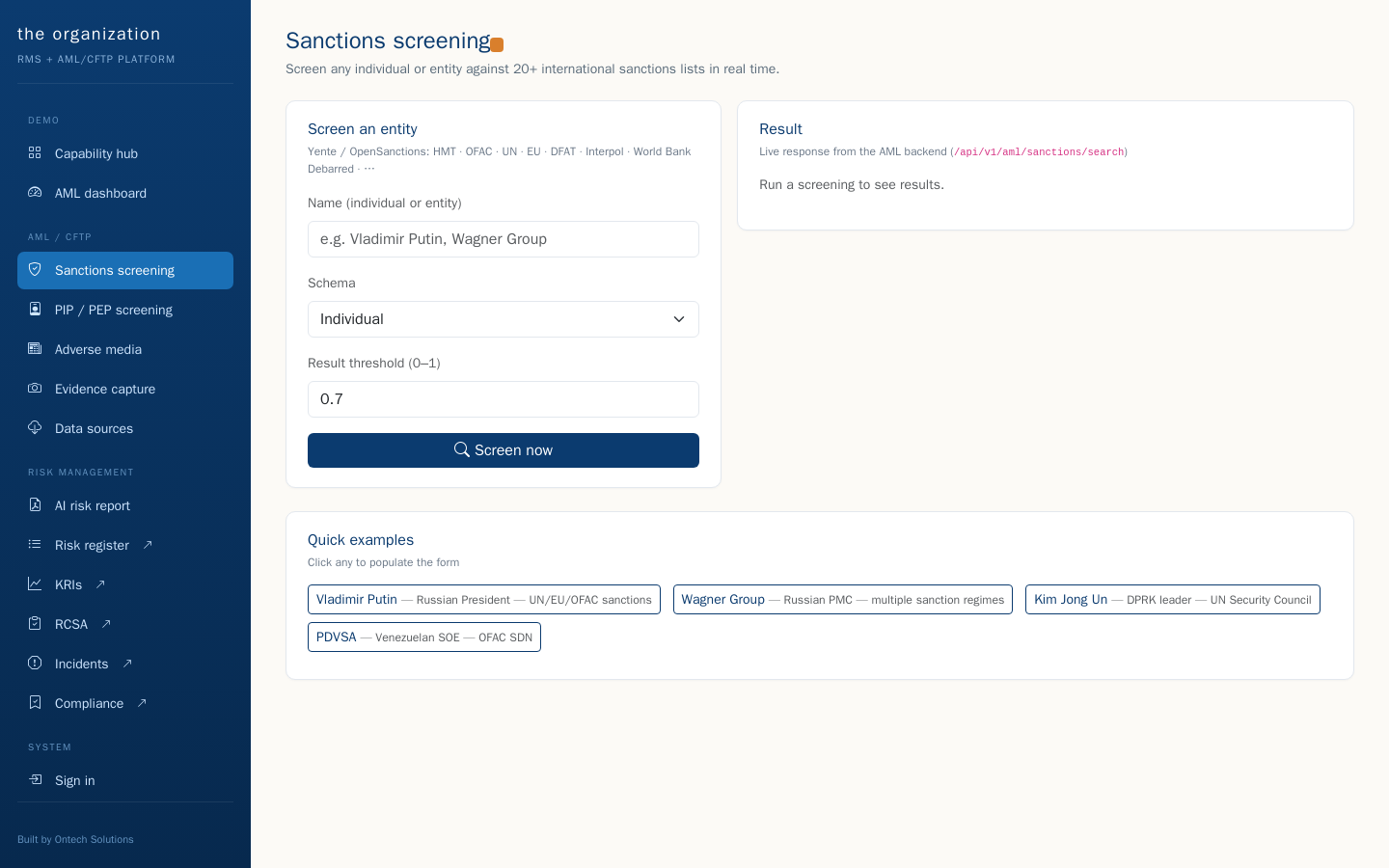
ERMAML, the Ontech Risk & Compliance Suite, screens against the UN Security Council Consolidated List, OFAC, EU and UK lists, the OpenSanctions dataset, the FIC PEP list and GDELT adverse media. Screening is built into onboarding, periodic review and a gate over settled payments, with an Elasticsearch-backed matcher, a false-match review queue and a reusable whitelist, developed by Ontech Solutions in Lusaka for institutions in Zambia.
Key capabilities
Multi-list coverage
UN, OFAC, EU and UK sanctions lists, the OpenSanctions aggregate and the FIC PEP list held locally and synchronised on a schedule, with no per-query call to an external screening vendor.
Fuzzy and transliteration matching
Elasticsearch-backed matching with alias expansion across scripts, so a name spelled three ways or written in another alphabet still produces the right candidate.
Entity-type filtering
Person, organisation and vessel filters applied in the query so a company name is not matched against an individual, which removes a common class of false positives.
Adverse media
GDELT-backed adverse-media scanning with severity scoring alongside the list match, giving analysts context before they decide.
False-match review and whitelist
Matches queued for four-eyes review; a dismissed false match is whitelisted so it does not reappear every time the list refreshes.
Screening gate
A detective gate over every customer and every settled payment, so a sanctioned party is caught at onboarding and again before money moves.
Evidence capture
Screening results, list versions and dispositions are logged on the tamper-evident audit trail, with server-side screenshots for evidence-grade captures.
How it works
- Sanctions, PEP and adverse-media sources are synchronised into a local index on a schedule.
- A customer, beneficial owner or payee is screened at onboarding, at periodic review and when a payment settles.
- The matcher returns candidates with a similarity score and the list each candidate came from.
- Analysts review candidates, confirm true matches or dismiss false ones under maker-checker control.
- Confirmed matches open cases; dismissed matches are whitelisted with the reason recorded.
- The list is refreshed and the customer base rescreened, with only new candidates surfaced for review.
Benefits
No more one-at-a-time website checks
The whole customer base is screened and rescreened automatically instead of names being typed into list websites by hand.
Analysts clear a false match once
The whitelist and entity-type filters stop the same false match returning after every list update.
Payments cannot bypass screening
The gate over settled payments means screening is not only an onboarding step.
Defensible decisions
Each disposition is recorded with the list version, the score and the reviewers, which is what an examiner asks for.
Who it is for
- Compliance analysts and MLROs responsible for sanctions and PEP screening.
- Money-transfer operators that must screen every transfer in real time.
- Insurers and pension funds screening claimants and beneficiaries before payout.
- Institutions that want screening evidence retained in their own system rather than a vendor portal.
Zambia-specific considerations
Zambian reporting entities are expected to screen customers against UN Security Council sanctions and to identify politically exposed persons, and the Financial Intelligence Centre publishes a PEP list for that purpose. Zambia's membership of ESAAMLG and its alignment with the FATF Recommendations mean examiners look for continuous screening rather than a one-off check at onboarding.
Local names are frequently spelled in several ways across the NRC, bank records and utility documents. Screening that combines fuzzy matching with registry-verified identity from the NRC and PACRA reduces both missed matches and the false positives that inconsistent spelling creates.
How ERMAML addresses this
Local lists, local index
The UN, OFAC, EU, UK and OpenSanctions sources and the FIC PEP list are held in the institution's own Elasticsearch index, so screening does not depend on an external vendor being available.
Identity checked before the name is matched
NRC, PACRA and ZRA verification runs alongside screening, so an analyst knows whether the person or company is who they claim to be before deciding on a list match.
Matches become cases, not emails
A confirmed match opens a case with maker-checker review and SLA escalation, and a sanctions hit can raise an incident in the ERM register.
Frequently asked questions
What is the difference between sanctions screening and PEP screening?
Sanctions screening checks whether a person or entity appears on a list of parties that institutions are prohibited from dealing with, such as the UN Security Council Consolidated List or OFAC. PEP screening identifies politically exposed persons, who are not prohibited but carry higher risk and require enhanced due diligence. ERMAML runs both in the same query.
Which lists does ERMAML screen against?
The UN Security Council Consolidated List, the OFAC SDN list, EU and UK sanctions lists, the OpenSanctions aggregate of public lists, the Financial Intelligence Centre's PEP list and GDELT adverse media. The sources are synchronised into a local index on a schedule.
How does fuzzy matching reduce missed matches?
Fuzzy matching scores names by similarity rather than requiring an exact string, and alias expansion handles transliteration from other scripts. A name written as Mohamed, Mohammed or Muhammad returns the same candidate, which an exact match would miss.
How are false positives handled?
Candidate matches go to a review queue where an analyst confirms or dismisses them under four-eyes control. A dismissed match is added to a whitelist with the reason recorded, so it does not resurface after the next list update. Entity-type filters remove person-versus-company mismatches before they reach the queue.
Is screening only done at onboarding?
No. ERMAML screens at onboarding, rescreens the customer base when lists change, rescreens at periodic review, and runs a screening gate over settled payments before funds are released.
Can the screening result be used as evidence?
Yes. Each result is recorded with the list version, similarity score, reviewers and disposition on a hash-chained audit trail, and the platform can take server-side screenshots for evidence-grade captures.
Sources
See ERMAML on your own data
Request a demo with Ontech Solutions in Lusaka and see sanctions screening, KYC, transaction monitoring, goAML reporting and the risk register working together in one platform.
Last updated 2026-09-13. Published by Ontech Solutions, Lusaka, Zambia.